
Business News | Addis Ababa | 10 November 2026
Ethiopia’s government says its economy is about 59 percent larger than previously measured. At a launch in Addis Ababa on 4 November, officials unveiled rebased national accounts that put gross domestic product (GDP) for the 2024/25 fiscal year at 24.03 trillion birr, or USD 201.42 billion, up from 15.09 trillion birr under the old series, and estimated 2025/26 GDP at 31.86 trillion birr, or USD 210.7 billion, the Ethiopian News Agency reported. The Ministry of National Strategy itself stresses that the change is one of measurement. Independent analysts and economists agree, and warn that while the new figures make Ethiopia’s debt look much lighter as a share of the economy, the debt owed, the repayments due and the taxes collected are exactly the same as before.
What the government announced
The rebasing moves the base year of the national accounts from 2015/16 to 2024/25 (2017 in the Ethiopian calendar). The revision adds 8.94 trillion birr to the previous estimate for 2024/25, a 59.21 percent increase, according to the Ministry of National Strategy report as described by Birr Metrics and Capital. “This does not mean the economy grew overnight,” the ministry said in its report, The Abay Times reported.
According to the ministry, the new accounts capture activity that was missing or undercounted, including artisanal gold mining, informal manufacturing, small scale construction, digital financial services and regional state owned enterprises. Minister of National Strategy Bereket Fesehatsion cited mobile money services such as telebirr, the new capital market, industrial parks, urban infrastructure, irrigation and higher wheat production as developments the old framework did not capture well, Capital reported. Bereket said the exercise drew on the agricultural census, the economic establishments census and household surveys, was carried out by Ethiopian professionals with technical assistance from the International Monetary Fund (IMF), follows the 2008 System of National Accounts, and will be repeated every five years, according to ENA.
Finance Minister Fitsum Assefa said the new figures would inform debt sustainability assessments, fiscal and monetary policy and efforts to broaden the tax base, ENA reported. Fitsum also said the figures placed Ethiopia fifth among African economies and third in sub Saharan Africa, according to Capital. A government presentation seen by Reuters claimed that “clearer economic data directly feeds into better credit ratings, lowers the risk premium on future international sovereign borrowing, and strengthens foreign direct investment inflows.”
What changed inside the numbers
Some sectors were revised sharply. Mining and quarrying rose 245.08 percent to 1.38 trillion birr, manufacturing 160.56 percent to 1.65 trillion birr, and electricity and water 495.35 percent, while real estate and business services were revised down 45.24 percent, according to the ministry figures reported by IntelliNews and Birr Metrics. These are changes in estimated levels, not growth rates, Birr Metrics noted. Under the new series, services make up 35.91 percent of GDP, agriculture 31.57 percent and industry 30.20 percent, Capital reported.
The picture of how Ethiopians spend and invest also shifted. Investment rises to 35.3 percent of GDP from 20.1 percent and savings to 30.9 percent from 13.2 percent, while private consumption falls to 64.4 percent from 80.9 percent, according to IntelliNews.
Questions about the size of the jump
The uplift is larger than officials had signalled. In June, officials guided towards an increase of 20 to 40 percent, Wazema reported, according to IntelliNews. For comparison, Kenya’s 2014 rebasing added 25.3 percent and South Africa’s revision last month added 5.3 percent, IntelliNews noted.
IntelliNews also found that the new series “runs hot”. Nominal GDP rises 32.6 percent between 2024/25 and 2025/26 against real growth of 7.7 percent in the new series, which implies an economy wide price increase of about 23 percent. That is well above the IMF’s estimate of 15.1 percent and average consumer inflation of 11.7 percent for 2025/26, the publication calculated. The ranking claim is also not straightforward. The ministry’s report itself does not compare its figures with international estimates or rank African economies, The Abay Times reported. IntelliNews noted that USD 210.7 billion would pass Morocco’s IMF estimate of USD 194.33 billion, but that other countries’ figures cover different periods and bases. Under the IMF’s April estimates, Ethiopia’s economy was USD 121.53 billion, behind Kenya at USD 147.26 billion.
Neither year in the new series captures the renewed fighting in the north. Fiscal 2025/26 closed in early July, and fighting spread from 23 September, when forces aligned with the Tigray People’s Liberation Front seized the civilian airports at Mekelle, Aksum and Shire, IntelliNews noted.
Lighter ratios, the same bills
The government has not published new debt or tax ratios. Holding the IMF’s pre rebasing estimate of about 8.73 trillion birr in public debt for 2025/26 constant, debt falls from about 45.3 percent of the old GDP estimate to 27.4 percent of the new one, according to calculations by both IntelliNews and Birr Metrics. “Outstanding debt, servicing costs, and foreign-currency financing requirements remain unchanged,” Alexander Venter of Oxford Economics told Birr Metrics.
The IMF’s July review still assessed Ethiopia’s debt as “unsustainable and in distress” and pointed to prolonged breaches in external debt service to exports and to revenue, two tests in which GDP plays no part, IntelliNews noted. Ethiopia missed a payment on its USD 1 billion Eurobond in December 2023 and is restructuring its external debt under the G20 Common Framework. Holders of the bond approved a preliminary restructuring agreement in August, Reuters reported. Debt repayments take 43 percent of recurrent spending, according to The Reporter, as cited by IntelliNews.
London based economist Abdulmenan Mohammed told Capital that the bigger GDP figure could sharply cut the reported debt ratio, but that he did not expect it to change the restructuring talks much because creditors also look at indicators such as export performance. “The way the GDP is measured neither makes Ethiopia wealthier nor benefits citizens,” Abdulmenan said.
Why businesses are watching the tax ratio
The same arithmetic works against the tax ratio. The IMF’s projection of about 1.83 trillion birr in tax collections for 2025/26 equals about 9.5 percent of the old GDP estimate but only about 5.7 percent of the new one, Birr Metrics calculated, describing the comparison as illustrative rather than an official ratio. The government’s medium term revenue strategy, adopted in October 2024, aims to raise tax collection to 13.2 percent of GDP by 2027/28, a target set against the old, smaller economy, Birr Metrics reported. Some IMF programme targets are set in birr, so the programme test itself does not change, IntelliNews noted, but keeping a percentage target against a much bigger GDP would require far more revenue.
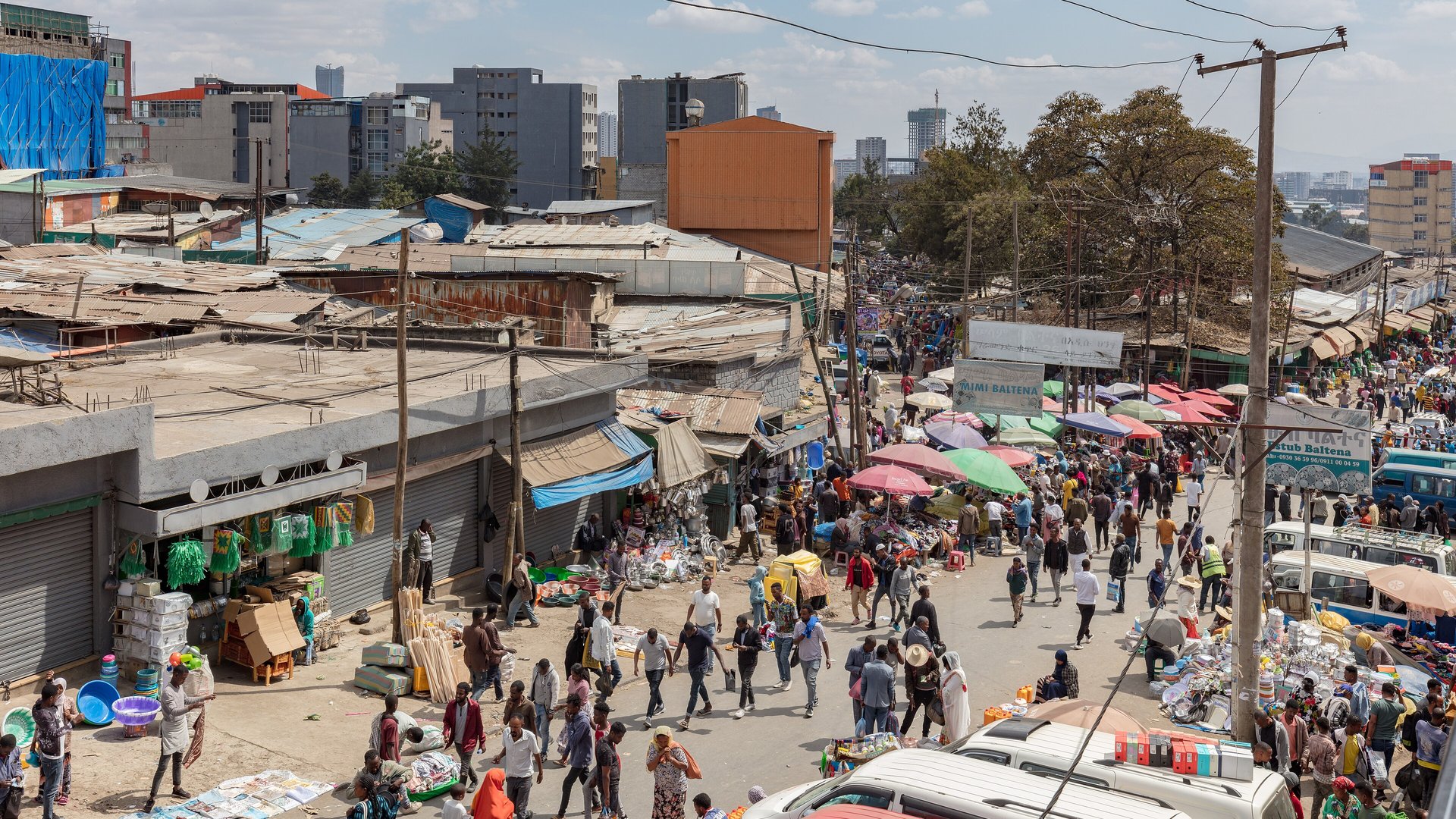
Fitsum said a more accurate measure of the economy would help the government identify opportunities to broaden the tax base, according to ENA. Abdulmenan warned that a lower tax ratio could encourage the government to widen taxation and intensify collection, adding pressure on businesses and households already facing difficult conditions, Capital reported. Traders interviewed by Birr Metrics in Merkato described weak sales, doubled shop rents and tax anxiety, although the publication noted that no evidence shows the rebasing itself has changed any individual tax assessment. Annual inflation was 14.9 percent in September, according to the official consumer price report cited by Birr Metrics.
Economists also cautioned against reading the revision as new wealth. “The 59 per cent is a change in the methodology, not a growth,” Tewodros Mekonnen, associate country director of the International Growth Centre, told Capital. Atlaw Alemu, an economics lecturer and researcher at Addis Ababa University, called the revision “very shocking” and was critical of the wider direction of economic policy, Birr Metrics reported.
Why it matters
Better national accounts can help businesses, lenders and investors see where activity is concentrated, from mining to digital payments. But the rebasing does not add a birr of revenue, reduce a dollar of debt or produce the foreign currency Ethiopia needs to repay creditors. The next test comes with the IMF’s sixth review of Ethiopia’s lending programme, with staff talks expected in the coming weeks and a board decision expected in early 2027, when the Fund will have to decide how far to adopt the new figures. For businesses, the more immediate question is whether the government uses the lower tax ratio to justify new revenue measures.
Related on Ethiopialist
- National Bank of Ethiopia Holds Policy Rate at 16 Percent as Money Growth Accelerates and Inflation Stays in Double Digits (Business News, 3 November 2026)
- Safaricom Ethiopia Cuts Half Year EBITDA Loss by 96.5 Percent as Revenue Rises 71.6 Percent, but a Calmer Birr Did Most of the Work (Business News, 7 November 2026)
- Qualified Ethiopian Investors Get a Route Into the Dangote Refinery IPO as Dangote Plans an ESX Listing for Gode Fertilizer (Business News, 22 October 2026)
- Ethio telecom listing (operator of telebirr)
- How to Send Money to Ethiopia: Fees and Options Compared
Sources
- Ethiopian News Agency, “Ethiopia Unveils GDP Rebasing, Economy Reaches 210.7 Billion USD”, 4 November 2026: ena.et
- Ethiopian News Agency, “GDP Rebasing to Lay Foundation for Ethiopia’s Long-Term Dev’t Ambitions: Minister”, 4 November 2026: ena.et
- Reuters via CNBC Africa, “Ethiopia revises economy up nearly 60% to $201 billion after GDP rebasing”, 5 November 2026: cnbcafrica.com
- bne IntelliNews, “Ethiopia rebases GDP to $210.7bn, shrinking debt and tax ratios on paper”, November 2026: intellinews.com
- Birr Metrics, “Ethiopia’s GDP Is Bigger, Its Tax Ratio Smaller. Who Will Pay the Difference?”, November 2026: birrmetrics.com
- Capital, “Economists Caution Against Equating GDP Revision With Real Growth”, 8 November 2026: capitalethiopia.com
- The Abay Times, “Rebasing lifts Ethiopia’s measured GDP by 59%”, November 2026: abaytimes.com
Last updated: 10 November 2026.
Send corrections to the Ethiopialist editors.
Featured image: Street traders and shoppers in Merkato, Addis Ababa, Ethiopia (January 2024). Photo: Diego Delso via Wikimedia Commons, licensed CC BY-SA 4.0, cropped and resized.