
Business News | Addis Ababa and Nairobi | 7 November 2026
Safaricom Ethiopia, the country’s first private mobile operator, cut its loss before interest, tax, depreciation and amortisation (EBITDA) by 96.5 percent to KES 434.4 million in the six months to 30 September 2026, according to half year results published by its Kenyan parent, Safaricom PLC, on 5 November. Service revenue rose 71.6 percent to KES 10.6 billion, and the business now counts 15.4 million three month active customers. Management repeated its target of EBITDA break even by the end of March 2027. Independent analysis of the same results shows that most of the improvement came from smaller currency losses, that the business is still deep in the red after network costs and interest, and that M-PESA Ethiopia lost active users during the quarter.
What Safaricom reported
By the company’s figures, Ethiopia’s service revenue grew 71.6 percent year on year to KES 10.6 billion and contributed 17 percent of the group’s service revenue growth. Measured in birr, revenue rose 102.1 percent to about ETB 13.1 billion, the gap reflecting the birr’s fall against the Kenyan shilling, according to Khusoko and tech-ish. Three month active customers rose 38.4 percent to 15.43 million from 11.15 million a year earlier, Business Daily reported, and 12.15 million of them were active mobile data users. Mobile data was by far the largest revenue line, supplying 81.2 percent of Ethiopian service revenue, with voice at 9.1 percent, Khusoko reported. Average data use per customer rose 14.8 percent to about 7.7 GB a month, according to the company’s results booklet.
“Ethiopia’s sustained growth and commercial momentum brings us closer to our target of achieving EBITDA break-even by the end of this financial year,” Group Chief Executive Peter Ndegwa said in the results release. Wim Vanhelleputte, chief executive of Safaricom Ethiopia, told investors that growth came from “more users, more usage, and a higher rate”, Business Daily reported. Safaricom Ethiopia raised its tariffs in December 2025, which helped lift the average price of a gigabyte to ETB 24.4, up 31.3 percent, according to tech-ish.
Most of the gain came from a calmer birr
A year earlier, the Ethiopian unit’s EBITDA loss was KES 12.56 billion, according to tech-ish. The Kenyan technology publication tech-ish calculated that roughly 69 percent of the KES 12.12 billion improvement came from smaller foreign exchange losses: in the six months to September 2025, when the birr fell 16.9 percent against the dollar, Safaricom Ethiopia booked KES 9.39 billion in currency losses, compared with KES 1.07 billion this year, when the birr fell 4.3 percent. The company also cut what it owes equipment suppliers on deferred terms from USD 148 million to USD 40 million, while its foreign currency loans rose from USD 200 million to USD 311 million, tech-ish reported. On tech-ish’s own arithmetic, the business would already be covering its operating costs if currency losses were excluded, so the March target depends heavily on the birr staying stable.
Safaricom also spent much less on its network. Capital spending in Ethiopia fell 47.2 percent to KES 5.0 billion, according to the company’s investor presentation, while the network grew to 3,624 sites from 3,504 in March, tech-ish reported. The new presentation says the company has launched 5G fixed wireless home internet in Addis Ababa, but gives no date or site count, tech-ish noted.
Still a large loss below the EBITDA line
Break even at the EBITDA level means revenue covers day to day operating costs, not the network, debt or tax. After depreciation, KES 4.92 billion in net finance costs and tax, Safaricom Ethiopia lost KES 16.6 billion in the half, and Safaricom PLC’s share of that loss was KES 8.8 billion, tech-ish reported. Its loss before interest and tax was KES 11.4 billion, down 53.4 percent, according to Khusoko. Total funding for the Ethiopian business reached USD 2.84 billion, and debt now equals 20 percent of equity, Chief Financial Officer Dilip Pal told investors, Khusoko reported.
M-PESA Ethiopia lost users in the quarter
The mobile money business remains small. M-PESA Ethiopia’s three month active users fell to 5.18 million in September from 5.69 million in June, and its one month active users fell to 2.15 million from 2.58 million, although both figures are higher than a year earlier, according to tech-ish’s reading of the company’s disclosures. Transaction value rose to about KES 18.4 billion in the September quarter, and one month active merchants rose to 108,970 from 89,877. M-PESA revenue in Ethiopia was about KES 10 million for the half, on a licence that cost USD 150 million. Safaricom’s own presentation lists “M-PESA interoperability and telecom-agnostic access” among unresolved issues, tech-ish noted. State owned Ethio telecom, whose telebirr service is far larger, reported 72.09 million active mobile subscribers at June 2026, according to tech-ish.
Pricing, regulation and conflict
Safaricom says it needs prices that cover its costs. “We do need pricing that reflects the minimum cost of delivering service,” Ndegwa said, according to Khusoko. Vanhelleputte said a regulatory directive sets a minimum price the market must reach over time and that the pace of further price steps depends on the regulator, Khusoko reported. The company’s presentation lists “delayed implementation of cost-based retail pricing” as a headwind, according to tech-ish.
Security is another risk. About 250 Safaricom network sites were forcibly shut down for about a week in late September amid renewed fighting in Tigray, Vanhelleputte told investors on the 5 November earnings call, according to Sable Africa. He said the sites had been restored and the impact was now “very limited, although the situation remains a bit volatile”. The company’s presentation now lists “renewed conflict in Tigray” as a risk, after describing the security situation as stable in May, tech-ish reported. Safaricom also cited inflation of 14.9 percent in September and continued currency pressures in Ethiopia.
Why it matters
Safaricom Ethiopia is the main test of whether Ethiopia’s partial opening of telecoms can create a lasting competitor to Ethio telecom. For businesses and consumers, the results point to more customers and heavier data use, but also to higher prices: the company is pressing for further increases toward a regulated cost based floor. Independent research has questioned how level the playing field is. A Clingendael Institute study published this year, titled “Liberalization on Paper”, argued that the state has continued to favour Ethio telecom, citing a 2023 rule that required fuel payments to go through telebirr and the blocking of Safaricom’s M-PESA Lehulum app on Ethio telecom’s network in December 2025, an issue the study says has since been resolved. Whether Safaricom reaches EBITDA break even in March will depend largely on the birr, the regulator’s pricing decisions and network stability in the north.
Related on Ethiopialist
- Safaricom Ethiopia listing
- Ethio telecom listing
- EthSwitch S.C. listing
- How to Send Money to Ethiopia: Fees and Options Compared
- National Bank of Ethiopia Holds Policy Rate at 16 Percent as Money Growth Accelerates and Inflation Stays in Double Digits (Business News, 3 November 2026)
- Ethiopia Joins the PAPSS Pan-African Payment System (Business News, 25 October 2026)
Sources
- Safaricom PLC, “Safaricom Group Net Income Surges 36% To KES 58.2 Billion as Ethiopia Start Up Losses Falls to KES 434.4 Million in HY27” (press release), 5 November 2026: safaricom.co.ke
- Safaricom PLC, HY27 Investor Presentation and Results Booklet, 5 November 2026: investor presentation, results booklet
- tech-ish, “M-PESA Ethiopia lost 510,000 active users in three months as Safaricom Ethiopia neared break-even”, 6 November 2026: tech-ish.com
- Khusoko, “Safaricom Ethiopia break even: price floor steps remain”, 5 November 2026: khusoko.com
- Business Daily, “Safaricom on brink of Ethiopia profit target”, November 2026: businessdailyafrica.com
- Sable Africa, “Safaricom Restores 250 Ethiopia Network Sites After Tigray Conflict Disruption”, 6 November 2026: sableafrica.com
- Clingendael Institute, “Liberalization on Paper: State Control in Ethiopia’s Telecom Sector”, 2026: clingendael.org
Last updated: 7 November 2026.
Send corrections to the Ethiopialist editors.
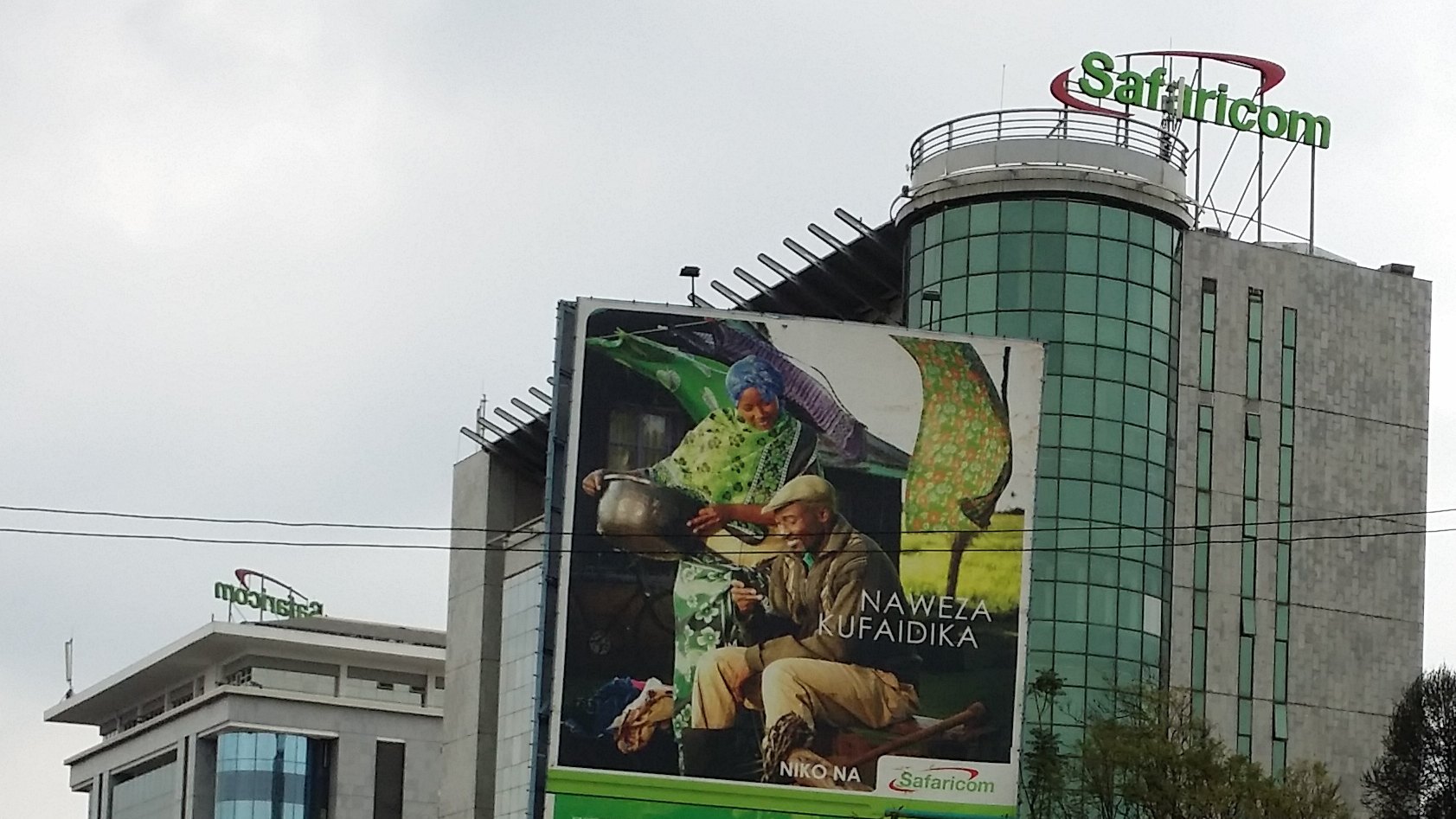
Featured image: Safaricom Centre, the headquarters of Safaricom PLC, the parent of Safaricom Ethiopia, in Nairobi, Kenya (2014). Photo: Nairobi123 via Wikimedia Commons, licensed CC BY-SA 4.0, cropped.